
Bent to your staircase, not to a standard radius.
Where a stair turns, the handrail has to turn with it. The bend is shaped to the geometry of that particular stair, which is why the measurements come before anything else.


Bent for an L-shaped stair
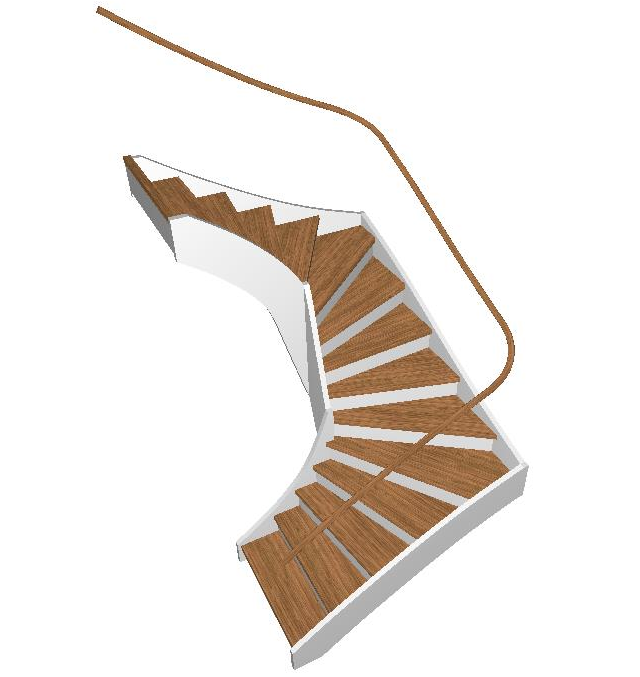
Bent for a U-shaped stair
Profiles
Bends and curved handrails are made in all our profiles, spirals included. The shop has the round ones, in 40, 42, 45 and 50 mm; other profiles and sizes are ordered from us. The straight runs above and below the turn are made in the same profile.
L and U
An L-shaped stair turns once, a U-shaped stair turns twice. Between them they cover most turned staircases; anything else is drawn from your measurements.
Measuring
A bend is shaped to one staircase, and the radius cannot be changed afterwards. The measuring guide sets out what to record, and in what order.
We measure
A straight handrail can be cut to length on site; a bend cannot. For curved and made-to-order runs we therefore take the measurements on site ourselves, which removes the tolerance problem before it arises. The measuring instructions are also available as a document and a film. Once the measurements are in, production takes 3–4 weeks, often less.
Corners and knees
Where two runs meet at an angle, a bend carries the profile round the corner in one piece, in the same profile and species as the runs on either side. A corner bend turns the rail in plan, a knee bend changes its pitch at an angle, and an easing does the same in a curve.
Timber through the turn
The bends are made in the same species and profile as the straight runs on either side. Ash is tough and bends willingly, and oak is the species we use most.
Leather and light
Leather-wrapped handrails are also available for L-shaped and U-shaped stairs and follow the same geometry as the timber bends. An LED strip can be milled into a curved handrail too – in the house on the LED page it follows the turn all the way up.
Installation
Our own fitters install the handrail, and if anything needs adjusting, it is adjusted on site. The installation instructions for handrails on curved stairs are available as a document and a film for anyone who wants to do it themselves.
The bends in the turn
Wherever the handrail changes direction or pitch, a bend is made. Knee bends and easings handle the transitions between flights and landings, and wreaths take the run from a flight to a level floor or on to the next flight. All the bend types, and when they are used, are on the page about bends and accessories.
Stair types and the handrail
How the handrail is shaped depends on the stair. Here are the most common stair types, and how the handrail follows each of them.
- Straight single-flight stair
- The handrail is straight.
- Straight stair with a landing, or L-shaped two-flight stair
- The handrail is straight. For full safety there should be a handrail both on the stair and on the landing.
- Quarter-turn stair with winders
- The handrail follows the stringer through the turn, or is made straight.
- U-shaped stair
- The handrail follows the stringer, or is made straight.
- Three-quarter turn stair
- The handrail follows the stringer.
- Free-form stair
- Handrail and railing follow the stringer.
- Spiral stair and U-shaped helical stair
- The handrail is helical.
